Sunday, June 13, 2010

more than you wanted to know about cassava


ok, so cassava is a tuberous root, similar to the potato that is the staple crop for much of sub-saharan africa. its originally from south america, but has been cultivated in africa for hundreds of years and takes varying shapes as a foodstuff (including tapioca pudding) but typically ground into a dough and eaten as a filler, often served with stew or meat.

positives:
  • it's drought tolerant
  • can grow underground for 20 months
  • very hardy
  • has easily available starch
sounds good, right?

bummers:
  • it rots quickly after harvesting
  • won't save in the raw form
  • contains naturally occurring cyanide
worse, cyanide concentrations increase in times of drought when, coincidentally, people are hungriest. so you must prepare it by soaking or fermentation, which removes the cyanide sufficiently to consume. this is all well and good on a small scale when you are consuming household size amounts but as a result of the efforts to improve food security, the village has formed an industrial scale processing plant which means industrial scale cyanide waste water. that's where we come in.


here's the processing plant

and here's the problem: what to do with toxic waste water?currently they are diverting it into a 15 meter deep collection well which will fill and they'll dig another, i.e. bad idea.

max, a med student from umass, looks pensively over the situation

ok, here's the process;
cassava harvested once from underground

a short shelf life means it needs to be close to end consumer

weekly, a truck collects cassava from local farmers and brings it to the processing facility


shares are weighed and farmers are paid 50 rwandan francs/kilo (10 cents USD)

sometimes goofy white people get in the way and waste your time by measuring and weighing stuff

women peel the cassava (imyambati in kinyarwanda) for 2.5 Rwfrancs/kilo


sometimes goofy white people get in the way and waste your time by measuring and weighing stuff again

sometimes goofy white people try to peel cassava and cut their fingers off

peeled cassava are washed in a tank to remove dirt and debris
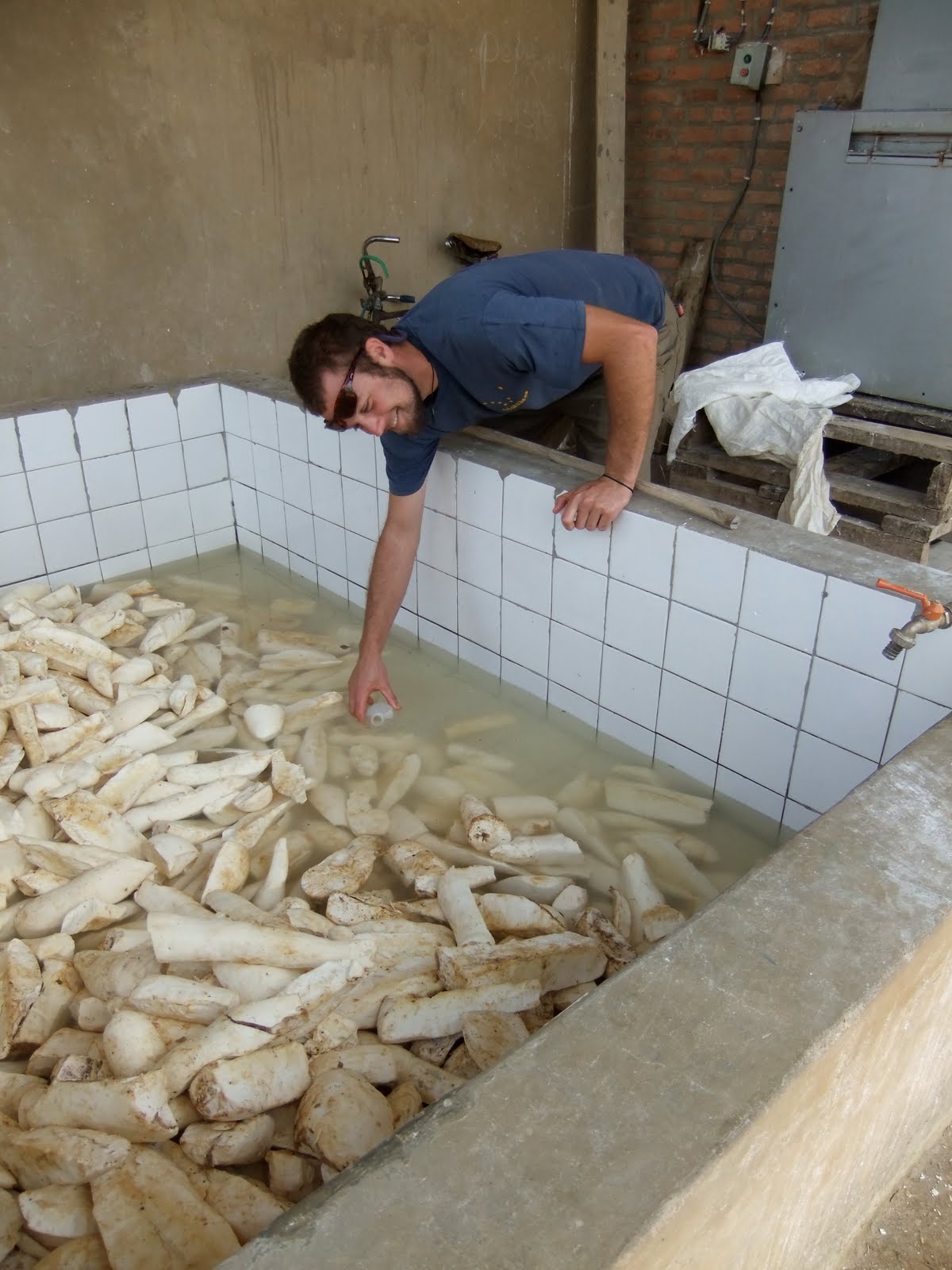
sometimes dorky white people sample wash water for cyanide

clean fruit is loaded into the rasper behind the men and chipped into flakes

this is on the other side of the wall from the rasper. the square opening in the back wall is the outlet.

the chipped cassava is bagged and set into these soak tanks that draw out cyanide for 2-3 days. the capacity of these tanks are ~3 metric tons apiece.

pressing the soaking bags to remove excess water

normally cassava is spread on the ground or on tarps to sun dry. this has become the hitch in the process because of the time and space needed.

the facility has built greenhouses and drying racks to improve efficiency...


unfortunately the are made of impermeable plastic (unicef tarps) which doesn't allow air to circulate
the flakes must be turned and raked to improve air flow

flaked, sun-dried cassava

they allowed us some space to experiment with a new design made of poly "burlap" sacks...

sometimes dumb white people tear up a perfectly good drying rack and mess up a full day's work

happy workers covered in cassava dust at the mill

some white guy pointing out the obvious

varying sizes of flour

sometimes the great white nerd (me) tries to help clean the grinding mill

flour is bagged into 5 kilo bags and sold locally and in the capital, kigali, for 2000 Rwfrancs (2USD)


i hope you weren't too bored with that intro. i will be putting together a video of what we are doing and some projects. thanks for reading!!!

Friday, June 11, 2010

school and cookstove

our research is centered in mayange, rwanda, which is a "millennium village", part of the UN millennium project. the aim of the project is eliminating world poverty, food insecurity, and improving health by the year 2015 (how's that going?) by funding demonstration villages through africa as models for combating these problems. mayange was a center of the 1994 genocides and was one of the most depressed areas in rwanda, with rampant famine and poverty, but is now quite stable and producing a surplus of food, which is where our research comes in. in our first days we visited a number of schools where fuel-efficient cookstoves were installed with funding through the project.


the simple, spartan classrooms are deceiving because the curriculum is rigorous and is now taught in english. rwanda, originally a belgian colony, was a francophone country but the very progressive president, Paul Kagame, has mandated english as the second language.


latrines for the students

taking water samples from the rainwater collection cistern

outdoor lectures on water cycle. this was a primary school lesson


fuel efficient stoves and maize (corn) ugali (dough-like filler) for student lunch

traditional cookstove, wood intensive and smoky

discussing the performance of stoves with headmaster

sampling cooking water from the utility tap, which is intermittent at best. water must be stored to weather the approaching dry season

Tuesday, June 08, 2010

windows into another world

wind, as it passes the over the body, convectively cools by evaporating sweat and heat and providing you with a satisfying feeling of comfort. this is a concept that i really like. in africa this law of physics is treated with more skepticism. windows were designed to facilitate this process and are standard in all vehicles except submarines. in the long hours i have spent in buses in arid east africa, i have become increasingly aware that there isn't international agreement in this law and of africans' aversion to physical comfort. it can be 75,000 degrees (F or C, whichever you are more comfortable with) in an overcrowded bus with everyone fanning themselves and sweating with the windows tightly shuttered, when someone will open a window to throw out a plastic water bottle. instantly everyone will be bathed in a refreshingly cool sensation. we all look around in ecstasy at the new-found pleasure and smile thinking isn't this nice and immediately close the window again. being the culturally sensitive man i am, i quietly suggest we do that again and am greeted with scorn, "pushy american!"
i have observed a similar phenomenon with my austrian sister-in-law. apparently in austria millions of people die every year instantly if two windows in the same room are open at the same time. the harm being that the crosswind, with its lethal ability to cool you off, will suck out your soul and leave you a lifeless corpse.
in conclusion, sometimes looking at the world through the perspective of another culture is important to evaluating your own, but this time i think i'm right to say that americans and physics have this one correct!!!

the art of haggling


the art of haggling is one of the great skills in life that americans don't appreciate. when traveling it can be a highlight or frustrating daily occurrence. in very touristy places like zanzibar where foreigners are pounced upon because of our naivety, i have come to understand that the art of bargaining not only gets you a better price, but earns you respect. locals, understandably, think we are idiots and need help in basic functions when they see tour groups of old ladies with cameras and fanny packs wobbling in and out of tour buses into shops. i cringe when i'm around other westerns and see them blatantly being ripped off. i now have taken it upon myself to remedy this problem with an introduction to haggling techniques from my observations:

the "bulldog" approach (aka john russell venable) - this approach requires one part theatrics and one part disbelief *. intimidating physical stature helps
step 1. immediately upon hearing the price of a good or service, one should throw up your hands, spin around, spitting is good, and stare in disbelief that the offer has offended your very soul and the offerer should get down and give you 20 push-ups
step 2. one should ask a ridiculously low counteroffer and repeat step 1
step 3. walk away and repeat with another vendor before realizing the first offer was fair and walk sheepishly back and ask for forgiveness
* john russell venable is a master of this

the comparison -
step 1. tell the vendor you saw the same one at another shop for 1/2 his price
step 2. inevitably he will tell you to go back to that shop and buy it from him then
*not the most effective technique

the too-tired-to-haggle -
step 1. ask half of first offer
step 2. accept first counteroffer
step 3. go to bed and vow to do better next time

nit-picker -
step 1. pretend to closely examine the ware, picking out the most microscopic flaws and explaining that this isn't top quality.
step 2. they will bring out paints to fix the problem, now you feel obliged to buy even though you didn't really even want the stupid, ugly painting.
*by the way mom i got you this really cool painting for xmas. it even has a new coat of paint!!!

the low ball (aka landon williams)-
step 1. find something you are mildly interested in
step 2. offer the amount of change you have in your sock or on top of the dresser
step 3. be astonished when they accept
step 4. take possession of object
step 5. place new object with the other low ball crap you have acquired through this approach
step 6. explain to your wife why you had to buy it and why the basement is filled with crap

the american -
step 1. pay full price

the walk-away -
step 1. pretend like you know a reasonable price and upon hearing the first offer casually walk out of the store
step 2. continue to walk away
step 3. return and pay the asking price

the andrew quincy -
step 1. set a price in your head
step 2. implement a barrage of the aforementioned approaches
step 3. walk away
step 4. return and pay full price
*very similar to the american

Sunday, June 06, 2010

rwanda: amazingly unafrican


i arrived yesterday in kigali, the capital of rwanda (pronounced "rhonda" like my middle school hairdresser). it is an amazing drastic change from western tanzania to rwanda. the arid, treeless plains of tanzania morph into pitched, forested green hills (hence "the land of a thousand hills"). immediately french is the second tongue spoken in the streets. shabby mud houses along the roadway turn to small, well-kept houses with small shrubs and manicured little patches of grass. i would not have believed it without seeing it, it's "un-african." the roads are orderly, plastic bags are outlawed, seat belts are worn, and motorbikes are required to provide helmets to passengers, it's very striking. rwanda has instituted a national program where once a month all residents are required to perform a day of service.


the professor that i'm working with from appalachian state university and i went with one of her former colleagues to visit her son at boarding school. the school is near volcanoes nat'l park in northeastern rwanda, two hours from the capital of kigali (pronounced chi-gali).

the children attend this boarding school from 12 years old to 18. they aren't allowed visitors but once a month. we had our bags searched to assure that we weren't giving them contraband food.
they attend classes from 5 am to 8 pm with an hour lunch. the curriculum is tough. i looked over the lesson which is all in english and i couldn't answer many of the questions, which isn't saying much but still...


in the background of is karisimbi volcano, of dian fossey fame. the climate is cool and foggy (gorillas in the mist). notice solar panels for water purification and rainwater collection.


every inch of open space is utilized in this small country roughly the size of maryland. during the rainy season it's green and lush and abruptly turns to brown during the dry. looking out over the landscape you see bananas, cassava, beans, sorghum.


Tuesday, June 01, 2010

on my way to the land of a thousand hills

i'm on my way to rwanda, the land of a thousand hills, now. i'm currently in dodoma, the capital of tanzania. unfortunately my camera was tired of traveling in my bag and decided to start a new chapter in its life with a crooked tanzanian, so i won't be uploading pictures, but it was an old camera and i consider it distributing the wealth. sorry for all the short posts but i hope to have better access when i get to rwanda this week.

Tuesday, May 25, 2010

zanzibarrrrrr


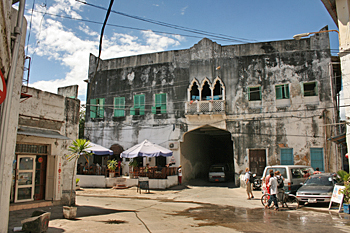
i think it sounds kinda exotic to say, but expensive to get here. 100$ visa and 70$ ferry ticket to the island from dar es salamm on the mainland. it's a fantastic old stone city, think the caribbean meets africa and a generous dollop of muslim, mossy decaying colonial buildings with unhinged unpainted shutters and archways ornately designed in arabic fashion. neato but they know what they have here and the locals are more ravenous then anywhere about "getting theirs." we are taking a tour of the spice trail today, as zanzibar was a major stopover port from the indian subcontinent to the western world.


doors are really cool (betsy moyer would love it). the story goes that there are indian and arab doors. the indian ones have these metal spikes sticking out, which are remnants from india where elephants were used to ram their way into compounds. as the indian spice merchants settled in zanzibar they brought this with them as a reminder of home and also as a status symbol, as metal was precious and ornamental.

Sunday, May 23, 2010

kenyan adventure


sorry it's been so sporadic keeping in contact, but i have a lot to report but limited time. since i met with john and his friend russ we have spent a good deal of time around mombassa, kenya in the southeast of the country. we have spent most of our days laying around beaches, putting on soccer (football) "clinics" to students of all nations, frequenting local humanitarian establishments (bars) and squeezing into bus seats sized for the average 5th grader in 90+ degree heat. the most interesting story was last night. we left the hostel around 7:30pm to watch a soccer match and apparently at 8pm, three armed gun men came in and robbed the place. everyone got to rest on the ground face-first and were relinquished of their wedding rings, laptops, cameras, and money. we always miss the fun. but everything is ok no one was hurt but a reminder to be safe.


we are now in dar e'salamm, tanzania, and are headed to zanzibar island tomorrow for a week before we split up. i'm headed by train to western tanzania and on to rwanda to meet the professor i will be working with on the cassava project, which i will explain later.

Friday, May 14, 2010

alive in africa


after 49 hours of travel i arrived in nairobi, kenya. it was an surprisingly enjoyable journey. i left charlotte at 1130 am had a 5-hour layover in minneapolis before boarding a KLM flight to amsterdam. the flight was late to leave because of security. because there were lots of muslim-sounding names on the flight, we went through 3 lines of US customs and security. the flight had to circumnavigate the volcanic ash in iceland which sent us over greenland. the engines seemed to stall near reykjavik, which kept things interesting. my seatmates were christian missionaries to norway (who knew norwegians needed saving). the woman asked me to pray with her, which was awkward. but we arrived safely in netherlands and immediately jumped on a plane to kampala, uganda. upon arrival i asked a muslim woman from the minneapolis flight about taxis to the bus station. she said that she would give me a ride to a hostel. i paid the visa and passed through ugandan customs. she and her son, though US citizens, were held with all somalis for interrogation. i waited in the baggage claim and met her husband, a huge somali, who had come to pick them up. after waiting a bit he walks backwards through customs, pays a bribe, and they come through without questioning. we loaded up in his lexus suv and headed into town. apparently he is an american citizen but enjoys living in uganda more than the states. they invited me to come over and watch the nba finals and play basketball with his friends, when i come back through kampala. i got the impression that they were well off, but it was confirmed when they dropped me off at the hostel and someone recognized him as the owner of several gas companies, auto parts distributors, tire shops, and they mentioned, 'this man doesnt have to wait to meet the president'. i'm a good judge of character huh.
anyway i slept for a couple hours and got a bus to kampala. 15 hours later i arrived in nairobi, caught a taxi to the hostel, and meet up with john and his friend russ. we headed to the club, renowned for its female companions, and i received an abrupt welcome to kenya. because of my intellect and sparklingly personality, i'm sure, the hookers really liked me. although i had some really interesting conversations on quantum physics and string theory, i came home alone. john woke me at noon. we had lunch and bought overnight tickets to mombossa, another 8 hours in a bus, where we'll stay for a couple days and then on to tanzania. sorry for the long letter. i promise to be more witty, provide more pictures, and be less sleep-deprived in the next post.